When I'm down and blue, feeling sorry for myself, I find comfort and solace in our garden. It's as important as the food we get from the earth and the eggs the chickens produce. And in some ways more important now with Wally in a more advanced state of dementia.
Our friends are gone now from the weekend. I went for a bike ride, played cards and we had a barbecue on Saturday. But now that everyone is gone, the caregiver taking his girlfriend back to the train station, it's just me, Wally, the dog, cat, and our garden. Wally and me, and our memories. I'm not sure what Wally can remember but I do for him. It's all we have.
Sometimes, I feel like tossing it all in. All the work and care to keep a house and garden up, to deal with caregivers and doctors, give it all up to hit the road in search of something better. But then I go outside and sit by the fountain remembering better days of laughter when Wally and I worked the land to make what we have today. How could I leave that behind?
Evening is approaching, my tears fall, the music of yesteryear plays, and I dream for Wally and me of better days. What more can I do?

Stories from living in Los Angeles
Sunday, March 16, 2014


Wednesday, March 5, 2014
Our Organic Garden In The MIddle Of The City
It's been awhile since I've posted because we had a defection from our ranks. The caretaker I had for Wally, who, as readers of this blog know, is my spouse and has vascular dementia was left by the caretaker without so much as a word that he was going, that and three hundred dollars. It's okay, the one before him took eight hundred, I got off cheap this time. Prince Albert turned out to be a frog, or I think a more appropriate title, Toad. The weasel left in the dead of night back to his hole in Cleveland. I really feel sorry for Cleveland, the pollution goes much further than the Lake Erie or the Cuyahoga river. It goes all the way to where this creep lives.
I've had to place an ad, (again) in Craigslist but this time, and I hope this time, things will turn out for the better. But instead of being cheap and not paying the twenty-five smackers for an ad in the job section, this time I did pay. We now have someone with knowledge from the jobs/healthcare section. He's straight too. We're as queer as three dollar bills but I'm not holding it against him. He is a trained technician in the field of home care. He actually helps, and rather than being told what to do, he knows what to do.
I'm not use to it yet, really, I actually got to eat a meal today without trying to feed Wally while doing it. He's a nice guy too, even if he is hetro. Now that we have someone here to care for Wally I can get back to writing, gardening and bicycling.

The grapes are budding out. When you see them about this size, five or six inches in growth, that's the time to use an organic copper fungicide. This will prevent mildew from ruining the tender ends until they grow bigger. Once they do grow more, you don't need to use the treatment. It protects the sprouts when they begin producing grapes. Just give them a good spritz once and that's it. Tomorrow, I will use the mineral oil to protect them from bugs and keep that up about once a month until the summer when they'll be ready for harvest near the end of summer.
Already I can see how they grapes will be hanging down beneath the trellis, enticing us until they're ready. Oh, goody.
And Oh, if you should go to Cleveland, and I don't know why anyone would, don't pick up any toads, they are good for the garden but not the ones in Cleveland.
I've had to place an ad, (again) in Craigslist but this time, and I hope this time, things will turn out for the better. But instead of being cheap and not paying the twenty-five smackers for an ad in the job section, this time I did pay. We now have someone with knowledge from the jobs/healthcare section. He's straight too. We're as queer as three dollar bills but I'm not holding it against him. He is a trained technician in the field of home care. He actually helps, and rather than being told what to do, he knows what to do.
I'm not use to it yet, really, I actually got to eat a meal today without trying to feed Wally while doing it. He's a nice guy too, even if he is hetro. Now that we have someone here to care for Wally I can get back to writing, gardening and bicycling.
View of Budding grapes and when to use the copper solution
The grapes are budding out. When you see them about this size, five or six inches in growth, that's the time to use an organic copper fungicide. This will prevent mildew from ruining the tender ends until they grow bigger. Once they do grow more, you don't need to use the treatment. It protects the sprouts when they begin producing grapes. Just give them a good spritz once and that's it. Tomorrow, I will use the mineral oil to protect them from bugs and keep that up about once a month until the summer when they'll be ready for harvest near the end of summer.
Already I can see how they grapes will be hanging down beneath the trellis, enticing us until they're ready. Oh, goody.
And Oh, if you should go to Cleveland, and I don't know why anyone would, don't pick up any toads, they are good for the garden but not the ones in Cleveland.
Tuesday, February 4, 2014
Our Organic Garden In The Middle Of The City
It rained, and enough to wet the ground, yet a friend ten miles away didn't get a drop. The weather is cold but very wintery for us in So Cal. And there was time to trim the grapes this last weekend.
Grape pruning for an arbor that produces table grapes is different than wine grapes and for grapes trained in a vineyard for table grapes. The first thing is to train the base grape vine to reach the top of the arbor. The vines need to grow above on the trellis support. Once this accomplished, two years at least, you can train them to grow above with the bunches of grapes hanging down, giving a stunning visual effect for the summer when they begin to ripen.

An arbor for grapes that allows people to sit under is a real delight. To reach up and taste the sweet abundant treat from where you stand is a wonderful experience at our backyard barbecues. Because of our arbor, two friends decided on the same thing. And why not? Grapes are very easy to grow here and pretty much anywhere save for the extreme north.

This is our sitting area beneath part of the arbor. It's winter and still a comfortable place to sit. On the edge beneath the arbor are assorted guavas. The grape vines shade the guavas from damaging sun of summer yet gives plenty of light when the weather cools and the sun's rays aren't as strong, perfect for guavas.
Pruning can be done at anytime even after the vines begin to leaf out, but I wouldn't wait much longer once you see the buds begin to turn green. I prefer to do it before that happens and yet keep the vines on through most of the winter. For us, February is a good time to prune.
First look at the vine's growth from last year and choose the best candidate for this year's crop. A vine that is sturdy and going in the right direction. You want a vine going right and another going left. Count ten to nine nodes from where the new vine comes out from the original old vine. That will give you double the new growth or twenty to eighteen new vines. Cut everything else off and tie it near the center of your trellis so that it can grow in both directions.
Notice in the after photo where last year's vine comes off the original older vine. All others are cut off and next year, we'll choose one vine from this last year's vine to continue. Grapes will only fruit from new growth. So every year you need to severely prune in this manner.
Once you have completed the pruning it should look like the photo above. With one vine going right and one left for each grape plant. We have four different varieties.
At each node along the saved vine will sprout new growth and with it, the grapes you'll harvest in summer. Once you see growth begin at the nodes spray with a mineral oil solution. We use, All Seasons, Horticultural & Dormant Spray Oil. It comes with an adapter for your hose to dilute the mineral oil. This will keep the tender leaves safe from pests and you'll want to spray about once a month at least. When the new growth is about six inches long, spray with an organic liquid copper fungicide to keep leaf mold from hitting your grapes. It only needs to be done once when the growth is new and tender, unless you live an a wet climate.
Now take all the vines you cut off and cut them up to save for your summer barbecues to smoke meats and fish. It is wonderful to use and you won't go back to hickory chips or any other wood for smoking once you tried grape cuttings.
Grape pruning for an arbor that produces table grapes is different than wine grapes and for grapes trained in a vineyard for table grapes. The first thing is to train the base grape vine to reach the top of the arbor. The vines need to grow above on the trellis support. Once this accomplished, two years at least, you can train them to grow above with the bunches of grapes hanging down, giving a stunning visual effect for the summer when they begin to ripen.
An arbor for grapes that allows people to sit under is a real delight. To reach up and taste the sweet abundant treat from where you stand is a wonderful experience at our backyard barbecues. Because of our arbor, two friends decided on the same thing. And why not? Grapes are very easy to grow here and pretty much anywhere save for the extreme north.
This is our sitting area beneath part of the arbor. It's winter and still a comfortable place to sit. On the edge beneath the arbor are assorted guavas. The grape vines shade the guavas from damaging sun of summer yet gives plenty of light when the weather cools and the sun's rays aren't as strong, perfect for guavas.
Pruning can be done at anytime even after the vines begin to leaf out, but I wouldn't wait much longer once you see the buds begin to turn green. I prefer to do it before that happens and yet keep the vines on through most of the winter. For us, February is a good time to prune.
First look at the vine's growth from last year and choose the best candidate for this year's crop. A vine that is sturdy and going in the right direction. You want a vine going right and another going left. Count ten to nine nodes from where the new vine comes out from the original old vine. That will give you double the new growth or twenty to eighteen new vines. Cut everything else off and tie it near the center of your trellis so that it can grow in both directions.
 |
| Before |
 | |||
| After |
 | ||
| Finished product |
At each node along the saved vine will sprout new growth and with it, the grapes you'll harvest in summer. Once you see growth begin at the nodes spray with a mineral oil solution. We use, All Seasons, Horticultural & Dormant Spray Oil. It comes with an adapter for your hose to dilute the mineral oil. This will keep the tender leaves safe from pests and you'll want to spray about once a month at least. When the new growth is about six inches long, spray with an organic liquid copper fungicide to keep leaf mold from hitting your grapes. It only needs to be done once when the growth is new and tender, unless you live an a wet climate.
Now take all the vines you cut off and cut them up to save for your summer barbecues to smoke meats and fish. It is wonderful to use and you won't go back to hickory chips or any other wood for smoking once you tried grape cuttings.
Thursday, January 30, 2014
Our Organic Garden In The Middle Of The City
We actually got enough rain tonight that you could smell it. The leaves became wet with drops of rain but not enough to put any moisture in the ground. No rain for our entire winter so far and little last year. It doesn't look good. We're going to dig out some groups of day lilies in the backyard and remove some grass by the front side. I wouldn't call it grass, more like the remnant of a lawn long ago. Slowly replacing grass that requires a lot of water for plants that will give food for a lot of water.
In place of the day lilies will be blueberries. I like the look of blueberries anyway, a darkish green leafy shrub that has beautiful blue fruit. You have to fight the birds for them but it will be worth it. Before the blueberries go in the alkaline soil will have to be dug out some and replaced with redwood compost--forest-type compost. Blueberries require acidic soil to fruit well.
I'm going to post pictures and write on how to prune table grapes on our arbor. We have two red seedless, one a flame, a Thompson and Concord. The Concord has a few small seeds, but the flavor, it's like a dessert wine when you bite into one. And It's time now, due to our weather, to prune the grapes for this year's crop. It's done a bit differently than a wine grape and the results are not only fruitful but beautiful.
The canes we'll prune from the grapes will be used for our backyard barbecues this year. The old vines will be dried to smoke meats, fowl and fish. Grape cuttings, in my opinion, are far better for taste in smoking when compared with apple, mesquite, or hickory. Pork ribs get mighty tasty over a low heat and the smoke of grape cuttings.
Also, we'll have to start planting garlic soon to get large bulbs by the beginning of summer. There's enough left over from last year to plant for this year. Good garlic too. And the compost we started a couple of weeks ago, and posted about, is just about finished. I'll take some photos of the end result and begin another batch once the tub is empty. The grapes will need a heavy dose of compost around their roots before new buds appear.
It was amazing how well the lemon tree came back with our homemade compost. Two years ago, we had one scrawny lemon and a very sick Meyer lemon tree. After heavy pruning and then sprayed with a mineral oil/ water solution, once a month to fight pests, plus mulching in good rich compost, gave us seven large, beautifully sweet-sour large lemons and this year, I'm hoping for a lot more fruit to set.
Hope we get some rain real soon. Next post with pics will be on pruning table grapes.
In place of the day lilies will be blueberries. I like the look of blueberries anyway, a darkish green leafy shrub that has beautiful blue fruit. You have to fight the birds for them but it will be worth it. Before the blueberries go in the alkaline soil will have to be dug out some and replaced with redwood compost--forest-type compost. Blueberries require acidic soil to fruit well.
I'm going to post pictures and write on how to prune table grapes on our arbor. We have two red seedless, one a flame, a Thompson and Concord. The Concord has a few small seeds, but the flavor, it's like a dessert wine when you bite into one. And It's time now, due to our weather, to prune the grapes for this year's crop. It's done a bit differently than a wine grape and the results are not only fruitful but beautiful.
The canes we'll prune from the grapes will be used for our backyard barbecues this year. The old vines will be dried to smoke meats, fowl and fish. Grape cuttings, in my opinion, are far better for taste in smoking when compared with apple, mesquite, or hickory. Pork ribs get mighty tasty over a low heat and the smoke of grape cuttings.
Also, we'll have to start planting garlic soon to get large bulbs by the beginning of summer. There's enough left over from last year to plant for this year. Good garlic too. And the compost we started a couple of weeks ago, and posted about, is just about finished. I'll take some photos of the end result and begin another batch once the tub is empty. The grapes will need a heavy dose of compost around their roots before new buds appear.
It was amazing how well the lemon tree came back with our homemade compost. Two years ago, we had one scrawny lemon and a very sick Meyer lemon tree. After heavy pruning and then sprayed with a mineral oil/ water solution, once a month to fight pests, plus mulching in good rich compost, gave us seven large, beautifully sweet-sour large lemons and this year, I'm hoping for a lot more fruit to set.
Hope we get some rain real soon. Next post with pics will be on pruning table grapes.
Saturday, January 18, 2014
Our Organic Garden In The Middle Of The City
What to plant? It's a good question when you consider in all the factors: time of year, size of the garden, and conditions most beneficial to the crop being planted. Then there is what you like to eat and a lot of times what we like and what can grow are in conflict. And for us, with limited space, and a smaller winter garden due to the shade of a neighbor's tree in winter, the consideration of rotating crops with a very limited light source in winter makes planning somewhat difficult for an all year around organic garden. But we do it and always seem to have something for the table that night.
Here, we have found garlic grows very well started in January-Febuarary and can be planted close together for space saving and is ready to harvest in June or early July. If interested in this make sure you use only organic cloves of garlic otherwise you'll have a problem getting them to start. On commercial produce, they spray garlic and potatoes with something that retards them from sprouting. You don't get that with organic products. We have enough garlic left over from last year to start this year's crop.
We plant beets at the same time, which are ready for harvest by April when we put in the tomatoes. But the trick is to rotate our crops otherwise the plants grow poorly and that requires, at times, to grow something new to eat to see how it works with our conditions. A mutual garden friend of ours that lives in another area of the city can grow things we can't and the same for him.
And for us, broccoli doesn't do well but kohlrabi does, leeks were a disaster but onions, garlic and beets are plentiful, and due to the loamy soil after so many years of cultivating, carrots grow long and straight and are particularly sweet and carroty. We also did well one year with okra, a beautiful plant related to hibiscus with delicate white flowers on a very nice bush-type plant.
Our grape vines will need to be cut back soon. Wonderful plant, if you want to smoke something, chicken, pork, fish--whatever, get a hold of some dried grape vines and use them instead of the usual hickory or mesquite. I think you'll find, as we did, that there is no better flavor imparted on smoked meats than grape vine cuttings. The entire grape plant can be used. the leaves, and of course the grape which we had hundreds of pounds of this year and then finally the precious trimmings of the vines. Nothing wasted. We also have guava, four different varieties growing under the grape harbor which gives us assorted guavas during the year. They love the winter sun and once the grapes sprout again after the cutting, the shade of summer to protect them in our desert climate.
It's like having your very own laboratory in your backyard, experimenting with this or that, trying something new, there is always something to consider when working the soil for food. And we love it. Nothing is more satisfying than to sit in the backyard with drink in hand and wonder at all the growth that an organic vegetable garden has to offer through the year.
Here, we have found garlic grows very well started in January-Febuarary and can be planted close together for space saving and is ready to harvest in June or early July. If interested in this make sure you use only organic cloves of garlic otherwise you'll have a problem getting them to start. On commercial produce, they spray garlic and potatoes with something that retards them from sprouting. You don't get that with organic products. We have enough garlic left over from last year to start this year's crop.
We plant beets at the same time, which are ready for harvest by April when we put in the tomatoes. But the trick is to rotate our crops otherwise the plants grow poorly and that requires, at times, to grow something new to eat to see how it works with our conditions. A mutual garden friend of ours that lives in another area of the city can grow things we can't and the same for him.
And for us, broccoli doesn't do well but kohlrabi does, leeks were a disaster but onions, garlic and beets are plentiful, and due to the loamy soil after so many years of cultivating, carrots grow long and straight and are particularly sweet and carroty. We also did well one year with okra, a beautiful plant related to hibiscus with delicate white flowers on a very nice bush-type plant.
Our grape vines will need to be cut back soon. Wonderful plant, if you want to smoke something, chicken, pork, fish--whatever, get a hold of some dried grape vines and use them instead of the usual hickory or mesquite. I think you'll find, as we did, that there is no better flavor imparted on smoked meats than grape vine cuttings. The entire grape plant can be used. the leaves, and of course the grape which we had hundreds of pounds of this year and then finally the precious trimmings of the vines. Nothing wasted. We also have guava, four different varieties growing under the grape harbor which gives us assorted guavas during the year. They love the winter sun and once the grapes sprout again after the cutting, the shade of summer to protect them in our desert climate.
It's like having your very own laboratory in your backyard, experimenting with this or that, trying something new, there is always something to consider when working the soil for food. And we love it. Nothing is more satisfying than to sit in the backyard with drink in hand and wonder at all the growth that an organic vegetable garden has to offer through the year.
Saturday, January 11, 2014
Our Organic Garden In The Middle Of The City
Even though Southern California is need of rain, and it can't rain soon enough for me, the weather has been extraordinarily beautiful. And though the sun's slant is still not the most beneficial for compost, the warmth we are experiencing this Winter makes up for it. I just started a fresh batch of compost in our compost maker, a large tub that can spin made out of recycled plastic. It's black exterior and paddles located on the inside help turn and get the compost cooking quickly.


Composter
The lid is facing up and slides open for easy access. It spins on aluminum legs and has held up now with year round use for a number of years. It takes at least two weeks to make compost but in the summer it can cook in about a week. Where the slits are located on the outside are the depressions for the paddles on the inside, so that you can easily turn the tumbler by pulling on the slits and the paddles, the inside part of the slits helps turn the compost over.
Ingredients for compost
Inside are layers of leaf matter of all kind from our gardens, kitchen scraps from vegetables, coffee and tea grinds, ash from the fire pit and barbecue, straw from the chicken coop and their poop. We layer it until the composter is filled to the brim, adding water to get it damp. I find that spinning it after adding water helps get the water soaked into the material without running off too much. The final product is pee. Just whip it out, if you have one to whip out, and piss right on top of everything, great if you do it more than once. That will get the reaction going really fast. You should be able to feel the heat coming off it that night.
Once the material inside shrinks to fill only half of the barrel it is ready to use. The more chopped up the material you add the better.
The Girls
The hens are the backbone to the whole garden. Without their waste you don't have all the ingredients for a good organic vegetable and flower garden. We have five Rhode Island Reds. And the plus are the eggs. I use only organic laying feed for them and they are very healthy. Inside the coop, which has plenty of space for them to roam, is straw I lay down to keep them clean and use in the the composter. Along with oyster shell for their shells and diatomaceous earth, which keeps pests like lice and such off the chickens when they take a dirt bath. It works great too. The coop is located at the back end of the property next to the alley with a sturdy chain link fence and Eugenia to give them shade and protection.
Morning facing the South Forty
We make enough compost from all the recycled material collected in our yard to cultivate our flower gardens and the vegetable garden. Once in a while, I still need to buy extra organic compost, a few bags a year at most with some years needing none. And though friends have requested compost, we really don't have any to spare. So it's almost a closed circuit with us using everything we grow to eat and recycle. Not bad!
Thursday, January 9, 2014
Our Organic Garden In The Middle Of The City
It's been a work in progress stretching back to 1985. That's when we had the house decent enough to live in after tenants from hell lived here. We had truck loads of trash, dead animals, and oil drained on top of the soil to deal with if we wanted anything but the remains of white trailer trash.
Once the havoc of filth was removed, a fence went up, now fortified with thick Eugenia and a tall redwood gate. A truck load alone of earth needed removed from where used oil from cars was poured. Once we got down to where no oil was seen or smelled, I dug another three feet down to insure no residue of oil could be present, all toll over seven feet of dirt had to be replaced. Fortunately in only one spot. Apparently the trailer trash had some values.
The earth was hard packed, so much that only a sturdy pick-ax could break ground. Gypsum went in, to break up the clay soil and then turned by hand with a shovel. That followed with a rotor-tiller and finally bag upon bag of organic compost. And over the years more compost, only now, with the help of the chickens, we make our own compost that almost satisfies the cravings of a healthy organic garden both flower and vegetable.
But it is the vegetable garden I love most. Especially in late Spring, it being the most beautiful time of year, I think. And now, from those humble beginnings, with a first year bumper crop of sun flowers, tomatoes and squash, we have four types of guava, four types of seedless grapes, lemons and dragon pepper tree that gives a cayenne pepper almost all year, and a year around garden of vegetables.
Right now we are harvesting radish, turnips, three kinds of lettuce and sugar-snap peas. Soon on the menu will be carrots but they need a tad more time until they're ready. And the turnip greens are wonderful, but the turnip's root need to get a bit bigger for a good meal.
Well, more later on how we compost using only ingredients found right in our backyard and the compost maker worth every penny we paid.
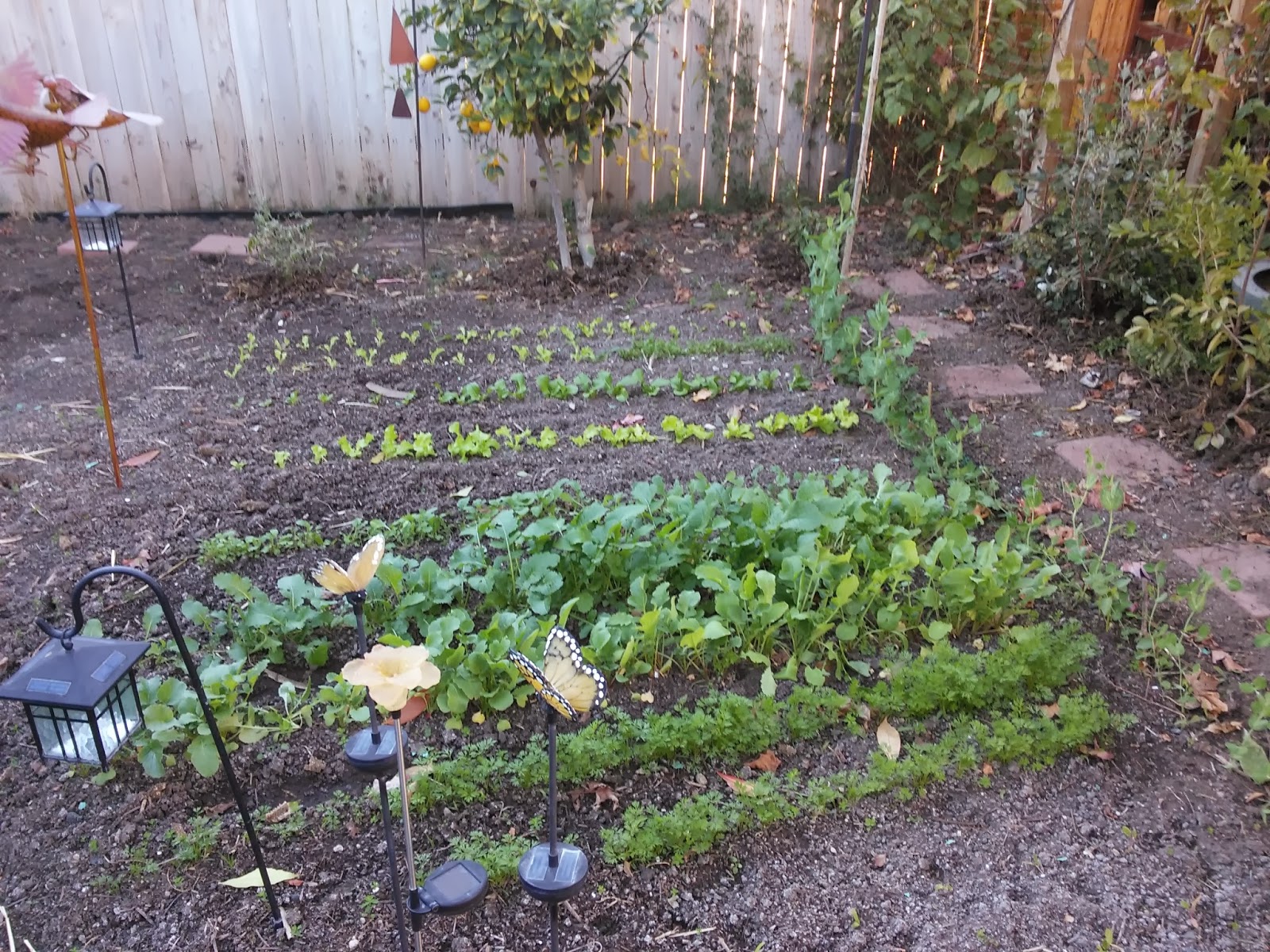 Photo taken mid-December of 12.
Once the havoc of filth was removed, a fence went up, now fortified with thick Eugenia and a tall redwood gate. A truck load alone of earth needed removed from where used oil from cars was poured. Once we got down to where no oil was seen or smelled, I dug another three feet down to insure no residue of oil could be present, all toll over seven feet of dirt had to be replaced. Fortunately in only one spot. Apparently the trailer trash had some values.
The earth was hard packed, so much that only a sturdy pick-ax could break ground. Gypsum went in, to break up the clay soil and then turned by hand with a shovel. That followed with a rotor-tiller and finally bag upon bag of organic compost. And over the years more compost, only now, with the help of the chickens, we make our own compost that almost satisfies the cravings of a healthy organic garden both flower and vegetable.
But it is the vegetable garden I love most. Especially in late Spring, it being the most beautiful time of year, I think. And now, from those humble beginnings, with a first year bumper crop of sun flowers, tomatoes and squash, we have four types of guava, four types of seedless grapes, lemons and dragon pepper tree that gives a cayenne pepper almost all year, and a year around garden of vegetables.
Right now we are harvesting radish, turnips, three kinds of lettuce and sugar-snap peas. Soon on the menu will be carrots but they need a tad more time until they're ready. And the turnip greens are wonderful, but the turnip's root need to get a bit bigger for a good meal.
Well, more later on how we compost using only ingredients found right in our backyard and the compost maker worth every penny we paid.
Subscribe to:
Posts (Atom)